
A quick disclosure before I get into this...
I advise some of the companies in this broader market. This piece is based only on public information, public announcements, public product pages, public market reporting, and my own read on where the category is headed. I’m not using private information, and any company examples are meant to show category movement, not to make procurement, investment, or endorsement claims.
With that out of the way, I think the Medallia news matters more than a typical software ownership storyline. Yes, once again it seems, we're here. First, a recap on the recapitalization. Medallia announced an agreement with lenders led by Blackstone, Apollo, and others that will shift ownership, reduce debt, and bring $150 million of new capital into the business. The company has said the transaction strengthens its financial foundation and supports a broader $500 million innovation commitment, with AI sitting at the center of the next chapter.
That's the official version, and it's an important market communication. For those who don't care about recapitalizations, it's as simple as this: A cleaner balance sheet gives the company more room to operate. A new ownership structure removes at least some uncertainty. New capital helps Medallia tell customers, employees, partners, and prospects that it has the resources to keep investing.
But the more interesting story is what this says about the market itself.
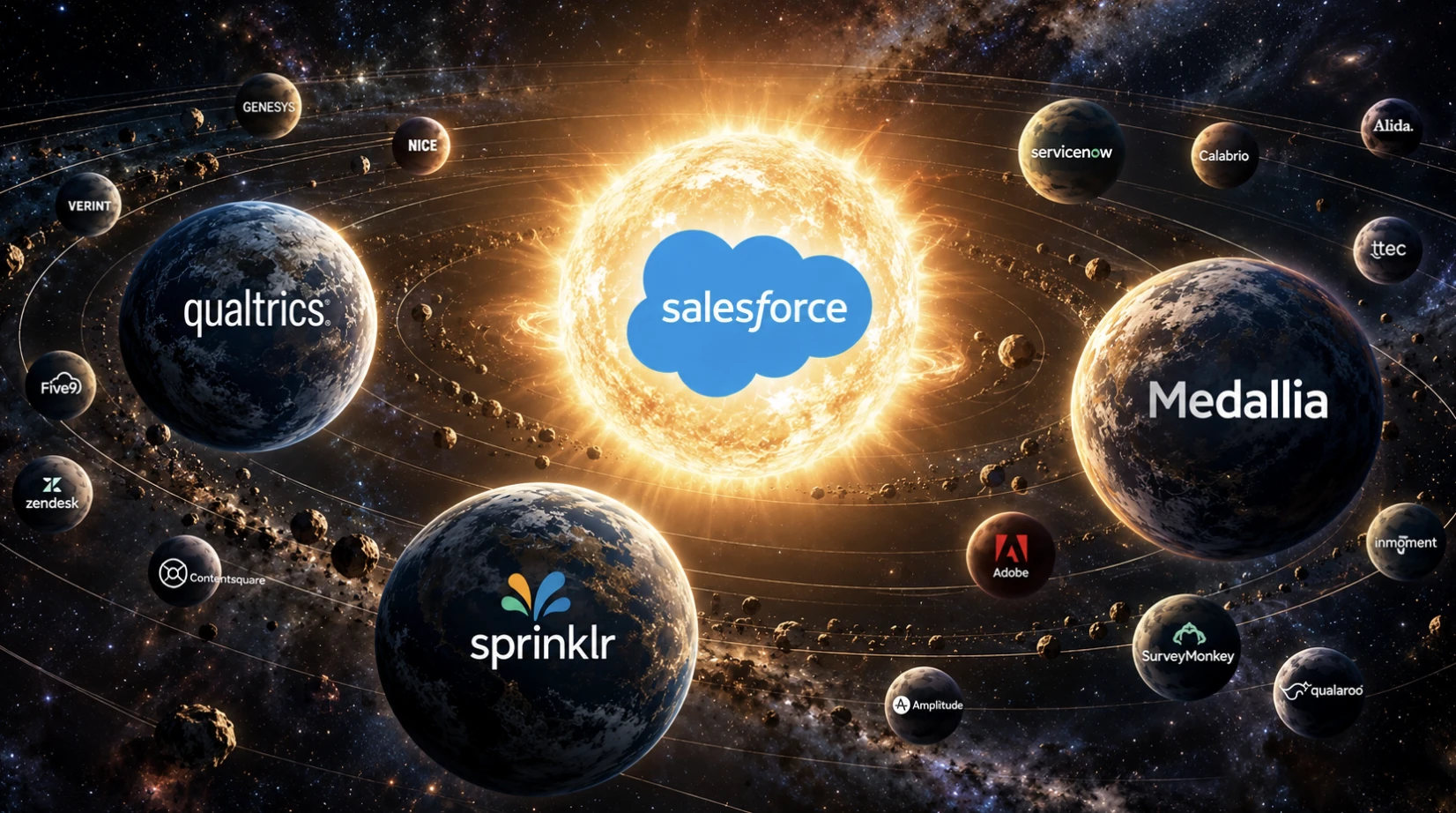
Medallia is trying to reset at the exact moment the old customer and employee feedback category is being pulled in multiple directions. The company isn't competing with Qualtrics anymore. It is competing with AI-native companies that are attacking service automation, product feedback, digital behavior, workflow, customer intelligence, research, and operational action. Some of these companies are small. Some are well-funded. Some are narrow. Some are trying to become much bigger. The important point is that they don’t need to replace Medallia or Qualtrics outright to create real pressure. They only need to take the next dollar.
This is where the story gets much more serious.
For years, large companies bought platforms like Medallia and Qualtrics to listen at scale, analyze feedback, manage programs, route issues, support governance, and give executives a clear view of what customers and employees were saying. That model had value, and in many large companies it still does. There is still a need for feedback infrastructure, program governance, permissions, reporting, survey management, text analytics, role-based visibility, and executive-level pattern recognition.
The problem is that AI is changing what buyers expect from the category. The old question was how to listen better. Then it became how to understand more signals faster. Now the question is becoming much more blunt: can this system help us fix the problem before it turns into cost, churn, risk, or customer frustration?
That is a much harder standard to execute against. But, it's also a better one.
A platform that tells leaders customers are unhappy is useful. A platform that helps identify why they are unhappy, which customers are affected, what action needs to happen, who owns the work, whether the work was completed, and whether the business result improved is far more valuable. That is the shift Medallia is trying to make. Qualtrics is trying to make a version of it too. So are dozens of other companies coming at the market from different angles.
The recapitalization gives Medallia a chance to compete for that future. It does not prove the company has already won the right to define it; although I don't think they're trying to do that right now to be fair.
What the news really means
Here's my outsider's take. Medallia gets new ownership, new capital, and a reduced debt burden. Public reporting has also made clear that Thoma Bravo’s investment did not work out the way anyone would have wanted when the deal was announced in 2021. That period in software now looks very different in hindsight. Valuations were high, money was cheaper, growth expectations were aggressive, and investors were betting that large SaaS platforms would keep expanding inside enterprise customers. Then the market changed. Interest rates rose. Software multiples came down. Enterprise buyers became more disciplined. AI started changing the product conversation. The tolerance for expensive, slow, broad enterprise software started to drop. Companies still buy big platforms, of course, but they are far less patient with tools that take too long to show value or require too much services work before business impact is visible.
Medallia is now trying to move into the next phase with a different capital structure and a much bigger AI message. That is a rational move. It is also a necessary one. The company had to give the market a stronger story than “we remain a large experience management platform.” That message would not be enough in 2026. Frankly, it wasn't enough in 2024 either, but who's counting.
The company’s public language is focused on moving beyond traditional feedback management into a more intelligent and automated model. The three areas it has highlighted publicly are conversational feedback, AI-driven action orchestration, and agentic automation. Directionally, that is where the market is going. Customers don't need another platform that simply collects more data and gives them more dashboards. They need a way to understand what is happening and act on it faster.
The phrase I keep coming back to, though, is Medallia’s description of adding an “AI-native platform layer” that is built from the ground up while still preserving and extending what customers rely on today.
I think I understand what they are trying to say. They are likely saying that the AI layer is being designed as a modern capability across the platform, not as a set of disconnected features bolted onto old modules. That is a fair and sensible product direction. But words matter, especially in a market where every vendor is now AI-native or trying to sound like it. A layer, by definition, sits on or across something else. It can be well-designed. It can be modern. It can be powerful. But if it's built to preserve and extend the existing platform, then it still has to work with the existing platform’s data structures, permissions, workflows, integrations, reporting models, customer deployments, and commercial commitments. (Frankly, my sense is that this is what Qualtrics has already built, they're just selling the layer with a different price point.)
That does not make it a bad strategy. In fact, it may be the only responsible strategy for a company with Medallia’s enterprise footprint. Large customers do not want their core customer and employee systems casually ripped apart in the name of AI. They need continuity, governance, security, auditability, and migration paths that do not create operational chaos.
Still, there is a difference between a company born around AI workflows and an incumbent building a new AI layer across an existing piece of real estate. Customers should not get hung up on the slogan. They should ask what the new architecture actually allows them to do that they could not do before, how quickly they can use it, and whether it reduces complexity or adds another layer of it. This, I think, is where the proof needs to show up.
The three investment areas are right, but the bar is high
Medallia’s three public investment areas make sense: conversational feedback, AI-driven action orchestration, and agentic automation. I would probably pick the same three if I were trying to tell the market where the category needs to go. The challenge is that each one can either become meaningful or turn into old thinking with a better label.
Take conversational feedback. There is nothing wrong with making feedback feel more natural, dynamic, and responsive. Long, static surveys have been a problem for years as shown by the ever-decreasing response rate so many CX leaders, and their executives, have tried to improve time and time again. Customers are tired of answering the same tired questions after every interaction. Employees are tired of chasing survey volume. Leaders are tired of reading dashboard cuts that confirm what they suspected all along anyway.
But if conversational feedback simply means turning the survey into a chat-like interface, I have to tell you, I'm not impressed. That is not a reinvention. That is a new wrapper around an old habit. Even the AI-native companies that are getting big Series A and B investments with similar solutions, frankly, surprise me that they're getting that type of investment for that specific function. Not taking a shot at investors, and maybe I've got it all wrong, but conversational surveys are not going to solve a companies experiential issues.
The better version is much more interesting. A modern feedback system should ask fewer questions because it already knows more context. It should understand the customer’s history, the interaction that just happened, the channel used, the product involved, the support history, the account value, the operational event, and the likely source of friction. In some moments, the best feedback question is no feedback question at all because the system already has enough behavioral, operational, and conversational data to infer what happened.
That is where conversational feedback becomes more than a friendlier survey. It becomes a smarter way of knowing when to ask, what to ask, and when to stop asking. And with the aggregation of disparate sources of data, both internal and external to your company, you can move from "what do we know about the customer?" to "what do we know as a company?"
The second investment area, AI-driven action orchestration, is the one I care about most. The customer feedback category has had an action problem for a long time. Companies have collected feedback, built dashboards, shared readouts, assigned owners, created action plans, and held steering committee meetings. Of course, some of that work helped. A lot of it created activity without enough change, too. Customers do not feel better because a dashboard is more advanced. Employees do not feel more supported because a theme was tagged correctly. The business only changes when someone fixes the broken policy, confusing process, digital failure, staffing issue, product defect, pricing confusion, training gap, or service handoff.
That is where Medallia and Qualtrics both need to prove they can move beyond the old model. If Medallia can detect a problem, understand the likely cause, trigger action in the right operating system, track whether the action happened, measure the result, and learn from the outcome, then the platform becomes far more important. If the product mostly summarizes feedback and recommends actions that still require people to chase the work manually, then it may be useful, but it is not a true category reset.
The third area, agentic automation, is the boldest and also the easiest to overstate. Every enterprise software company now wants to talk about agents. The promise is obvious. AI should not only help humans understand what happened. It should help do the work. It should resolve issues, escalate exceptions, coordinate across systems, personalize responses, and keep learning.
That is certainly the direction of travel, but anyone who has worked inside a large company knows how quickly the real questions appear. Which systems can the agent access? What action can it take without human approval? What happens when the customer is high-value, regulated, vulnerable, angry, or in a sensitive moment? How does the business audit the decision? How does the agent know the issue was actually resolved? What permissions does it inherit? What data can it use? How does it avoid creating risk while trying to reduce friction? These questions are not reasons to avoid agentic automation. But they are very real reasons to get serious about it, no matter what size organization you're part of.
And maybe this is one place where Medallia’s enterprise history can help. The company knows complex deployments. It knows regulated customers. It knows permissioning, governance, and global enterprise realities. Smaller AI-native companies can sometimes underestimate how messy that world is. At the same time, Medallia has to avoid using enterprise complexity as an excuse for slow product movement. Buyers are not going to wait forever for a clean answer.
The market is no longer Medallia versus Qualtrics
For a long time, the category conversation was mostly framed as Medallia versus Qualtrics. That made sense when the market was primarily about enterprise feedback, survey infrastructure, employee and customer listening, text analytics, dashboards, benchmarks, and program governance. That is no longer the whole market though.
Qualtrics is still a major competitor. It has brand strength, enterprise reach, research credibility, and a strong AI message of its own with Experience Agents and its broader XM platform positioning. It is also arguing that the more feedback and context a company captures inside the platform, the more powerful its AI becomes. That is a logical argument, and it will resonate with some customers.
But Qualtrics faces a version of the same question Medallia faces: is AI strengthening the old platform model, or is it making it easier for companies to buy narrower tools that solve sharper problems faster?
That question is super important right now because the next wave of competition is not one vendor replacing another across the enterprise. It is a series of smaller attacks on the most valuable parts of the old model. Just look at companies like Sierra and Decagon as good examples on the service automation side. They are not trying to replace every survey program, every employee listening use case, every research workflow, or every executive reporting layer. But they are absolutely competing for the budget attached to customer service automation, issue resolution, support containment, agent productivity, and customer problem-solving.
That budget is dangerous because it is often closer to the CFO as it has super sharp economics. Reduce repeat contacts. Improve containment. Lower cost to serve. Resolve issues faster. Reduce escalations. Protect revenue. When a vendor can tell that story in plain financial language, it has a different kind of pull than a vendor talking about better listening or faster insights.
Then there are companies attacking product feedback, customer intelligence, research automation, digital behavior, contact center coaching, workflow orchestration, and customer-led planning. Some are focused on unstructured feedback. Some are focused on turning customer signals into product decisions. Some are focused on helping teams act faster inside the systems where work already happens. The names will change. Some will win, some will fade, and some will be absorbed into larger platforms. The broader pattern is the point.
So I think today, Medallia and Qualtrics no longer get to assume that the customer problem belongs inside their category. Too note:
A product leader may not need a full enterprise feedback platform to understand which customer issues are affecting roadmap priorities.
A support leader may not need a broad experience management program to justify an AI agent investment that reduces volume or improves resolution. A digital leader may not need another customer dashboard if a behavioral analytics tool can show exactly where customers fail in the app.
An operations leader may not care about a sentiment score if a workflow platform can trigger the fix and track whether it happened and what impact it had.
This is the pressure Medallia and Qualtrics are now under. They can remain important and still lose the most valuable new dollars being spent. They can keep renewals and lose expansion. They can stay in the stack while the center of gravity moves somewhere else. We're already seeing analytics happen outside of these platforms, not inside them; so why wouldn't other use cases gravitate to different capabilities?
This is how incumbents get hollowed out. It's not an overnight process or a dramatic rip-and-replace moment. It happens when the platform remains in place, but the next dollar, the next executive priority, and the next measurable business outcomes move to a more focused tool.
Now the fight turns into who owns the work
The old category was built around listening and understanding. The new fight is about work and outcomes.
- Who owns the action when a customer is at risk and what's the impact?
- Who owns the fix when a product issue is driving support volume and what does it achieve?
- Who owns the response when a billing process creates repeat complaints and how does that impact our cost-to-serve?
- Who owns the change when a digital flow causes abandonment and what's the impact on our growth targets?
- Who owns the intervention when an employee issue affects service quality and what happens to retention?
Those questions seem simple to put into an article on LinkedIn, but inside large companies they are anything but that. The work usually lives across multiple systems and teams. The CRM may hold the customer record. The contact center platform may hold the conversation. ServiceNow may own the workflow. Jira may own the product fix. Adobe may own the digital path. Snowflake or Databricks may hold the data. Teams or Slack may hold the daily conversation and coordination. Finance may hold the economics. The actual human work may still happen in a spreadsheet because the official system is too painful. (And let's be honest, this last point happens inside the Fortune 50 as much as it does in the Russell 2,000.)
This is the reality operators have to deal with.
A feedback platform can say it recommends action, but recommendations alone do not change a business. A leader still has to decide who owns the issue, what system the work belongs in, what approval is required, how the action is tracked, the input metrics that need to be agreed to, the systems and queries that pull that data need to be aligned on, and once all that is done, you need to agree on how the result is measured and who owns that. If Medallia (or Qualtrics) wants to be more than a system of insight, it has to become much more connected to the systems where work happens every day. And that is the messy middle they need to somehow connect to.
This is also where the “AI-native layer” language will be tested (contested?). If the layer can see signals, understand context, trigger workflows, respect permissions, and measure outcomes across systems, then it is a serious enterprise capability. If it mostly sits above the old platform and creates better summaries and triggers faster, then buyers will be back to 2020. Customers should push harder.
The question of does the platfrom have AI is useless now. We need to ask for production examples where the system aggregated disparate sources of data, detected an issue, identified the likely cause, triggered an action in another system, tracked the completion of the work, measured whether the customer or business outcome improved, and learned from what happened. If this isn't the bar based on Corporate Comms is telling us, I don't know what is.
If a vendor can show that across multiple, real customers and use cases, then you need to stand up and pay attention. If the proof is demos, roadmap slides, suggested replies, topic summaries, action plans, and "here's what it could look like for you," then be honest about what you are buying. Those capabilities may have value, but they are not the same as changing the day-to-day operations of your business.
The fairest read at the end of the day
I think Medallia is making the right strategic pivot from a difficult starting point. That is probably the fairest read.
The company is not dead, and anyone saying that is being lazy or has some axe to grind. Medallia has large enterprise customers, deep deployment experience, a meaningful brand, security credibility, years of customer and employee signal history, and a lot of knowledge about how complex companies actually run these programs. Those assets actually matter in the enterprise SaaS space.
The recapitalization also gives the company a badly-needed story than it had before. Customers who were worried about the capital structure now have a clearer answer. (Hopefully) employees have a clearer signal about the path forward. Prospects have a stronger reason to keep Medallia in the evaluation. The new owners have publicly backed the leadership team and the platform strategy, at least for now. Those are positives.
But this announcement should not be confused with proof that Medallia has already reinvented itself. It means the company has bought itself the chance to do so. That distinction is really important.
The next 12 months will tell us far more than the announcement that came out yesterday. Can Medallia turn the new capital into speed? Can it simplify the market and customer reality? Can it reduce implementation drag? Can it make AI useful inside the daily flow of work rather than mostly inside executive reporting? Can it defend renewals while also winning the expansion dollars that might otherwise go to AI-native competitors? Can it show value in different languages that the CFO, COO, CIO, CTO, CMO and line leaders care about?
All of that really is the work ahead.
I also think the leadership question should be handled with some nuance. The public language around the current leadership team is supportive. The company has said a new executive team joined about 18 months ago to reinvent the business for an AI-first market, and the recapitalization language points to confidence in the leadership team and platform strategy. That suggests continuity, at least initially. But continuity is not security.
You see, in other lender-led ownership transitions, incentives change, board pressure changes, and reporting changes. The company may have more room financially, but the performance expectations will likely become sharper. To be clear, this isn't a criticism. It's just what happens when creditors become owners and a company has to prove that a cleaner balance sheet can translate into growth. If the strategy works, the current team gets credit for the turnaround. If the strategy does not show enough progress quickly enough, my guess is that leadership continuity can change just as quickly. Customers should not overread the current setup as proof that everything is solved. It is better understood as a practical bet that the current team is the best near-term path to stabilize the company, preserve customer confidence, and accelerate the AI roadmap. But just like in Vegas, that bet still has to pay off.
What I’d hope Medallia spends the $150 million on
The $150 million number only matters if it creates a different customer reality. I'm not running the company of course, but that's where I would focus.
I would not want to see this money turn into marketing and marketecture. The market does not need another vendor saying it has AI everywhere. Everyone has AI everywhere now, at least in the way software marketing talks about itself.
The better investment is what makes Medallia faster, simpler, more useful, and more connected to the work companies actually need to change.
If I were a Medallia customer or a potential customer, I would hope a meaningful portion of the money goes into product simplification. That may not be the flashiest investment, but it may be the most important one. Large enterprise platforms have become complicated over time. They accumulate modules, admin layers, permission structures, workflow rules, reporting objects, services dependencies, naming conventions, and internal product seams that customers have to navigate.
AI will not automatically fix that. In some cases, AI sitting on top of a complicated platform can make the whole thing feel even heavier because customers now have to understand the platform, the AI layer, the governance model, the integration approach, the permission structure, and the risk controls. That is a lot to ask of teams that are already stretched.
So yes, build advanced AI. But also make the platform easier to buy, easier to implement, easier to administer, easier to connect, and easier to prove value from. Less friction may be a more powerful product move than another feature announcement.
I would also have Medallia spend heavily on implementation speed. This is where legacy enterprise software gets exposed badly. If a customer needs months of setup, workshops, mapping, services work, configuration, dashboard development, governance design, and custom integrations before meaningful value shows up, then focused AI-native competitors will have a clear opening. And the door is already wide open enough for them to walk right through it.
Medallia does not need to become a lightweight tool. That is not its lane, and large enterprises still need controls. But it does need to reduce the time between contract signature and business impact. Faster integrations, more repeatable deployment patterns, better templates, cleaner migration paths, and lower services dependency would do more for customer confidence than another broad AI claim.
The biggest investment, though, should be the action layer.
Medallia’s historical strength is listening, feedback, analytics, and enterprise program management. That still matters, but the market has also been moving toward action for some time. The question is not whether Medallia can summarize feedback better. I assume it can. The question is whether Medallia can help a company do something meaningful with the signal.
Can the platform detect a recurring billing problem before it spreads? Can it identify which customers are affected and what those customers are worth?
Can it understand whether the likely cause sits in policy, process, product, channel design, training, staffing, or communication?
Can it trigger the right workflow in Salesforce, ServiceNow, Jira, Teams, or another system where the work already happens?
Can it track whether the work was completed?
Can it measure whether repeat contacts fell, resolution improved, churn risk declined, digital completion increased, or customer effort dropped?
Can it learn from that result and get smarter the next time?
That is where the money should go.
Not just insight. Not action plans in the old sense. Real operational action that connects signals to work and work to measurable outcomes.
I would also make serious investment in integration depth. Basic connectors are not enough. If Medallia wants to be the customer intelligence and action layer for a large enterprise, it has to connect deeply into CRM, contact center, workflow, product analytics, marketing automation, data warehouses, collaboration tools, HR systems, and custom operational systems. It has to understand context from those systems, trigger work inside them, respect their permissions, and measure outcomes across them.
This is hard, and incredibly unglamorous work; but it separates a serious platform from a nice AI story. Data quality and identity resolution should also deserve serious money. This area gets less attention than agentic AI, but it matters more than most understand. AI is only useful if it understands who the customer is, what happened, which signals are reliable, what context matters, and what business outcome is at stake. Many companies still have feedback in one place, support data in another, CRM data somewhere else, product usage in another system, and financial context locked away from the teams who need it.
If Medallia can help companies connect those dots more cleanly, that becomes a real advantage. If it cannot, the AI layer will only be as good as the fragmented data underneath it. Integration of disparate sources of data, unstructured and structured, has been the sales pitch for a while, but it's harder than it sounds to execute.
I would also spend on proof of value in plain business terms. The market is tired of soft claims. Better insights, connected experiences, AI-powered transformation, and democratized intelligence are not enough. Show the business result. Reduced repeat contacts. Lower cost to serve. Faster resolution. Higher retention. Improved digital completion. Fewer escalations. Lower churn risk. Better employee capacity. Better product decisions. Shorter time from signal to fix.
Customer migration and contract flexibility should be on the list too. If Medallia is asking customers to believe in a new AI-led platform direction, customers need a practical path from where they are today to where Medallia wants to take them. That path cannot feel like another expensive reimplementation. It cannot require customers to rip apart their operating model before they see value. It cannot bury customers in services hours before they see proof.
Give customers clear migration options. Make AI capabilities easy to adopt in phases. Help them start with specific use cases. Let them prove value before expanding. Make commercial terms flexible enough that customers can test the new direction without betting the entire program on a roadmap.
Finally, I would spend on trust, governance, and control. This is one of the places where Medallia can create real separation from similar players in the marketplace. Large enterprises are not going to let AI agents run loose inside customer and employee systems. They need permissions, audit trails, human approval, data boundaries, model governance, security controls, regional privacy support, clear escalation paths, and explainability.
The work is boring until something goes wrong. Then it becomes the whole conversation. Just look at the cyber security space as a inspiration. Once you're hacked and have a ransom on your system access, executives start to open up the purse quickly.
If Medallia can make AI action safe, explainable, controlled, and measurable inside large enterprises, that is a meaningful advantage. If the $150 million turns into speed, simplicity, integration depth, action, trust, and proof of value, the company has a real shot. If it turns into more positioning, more packaging, more demos, and more future-state language, the market will keep moving on, just faster.
So where do I think this is headed?
I think the customer and employee feedback category is headed toward a split.
One part of the market will remain enterprise program management. Large companies will still need governance, survey infrastructure, compliance, role-based reporting, research workflows, employee listening, benchmarks, permissions, data controls, and executive visibility. Medallia and Qualtrics can defend that layer because it rewards enterprise maturity, security, scale, and deployment experience. But the economics on this side of the ledger aren't attractive.
The other part of the market will move toward customer intelligence, action, proof, and increased velocity around all three. That layer will be more fluid, more fragmented, and more connected to operational systems. It will be tied to service, product, digital, sales, retention, cost reduction, employee capacity, and workflow. It will feed on changing business behavior.
Some companies will still prefer one broad platform, and that's fine. They will value stability, security, account coverage, and an enterprise-wide model. For those buyers, Medallia and Qualtrics will remain very relevant.
Other companies will build a more modular stack. They may keep a core feedback platform while adding AI agents, customer intelligence tools, workflow automation, product feedback tools, contact center AI, digital analytics, and internal builds. That model will appeal to buyers who are tired of waiting for large platform roadmaps and want more measurable progress against specific problems.
This is why Medallia and Qualtrics have to be careful. The danger is not always losing the whole account. The danger is becoming the retained platform of record while the exciting work, new budget, and executive attention move elsewhere.
A CFO may approve the renewal because the platform is embedded. The COO may fund the AI agent. The product leader may fund the customer intelligence tool. The CIO may fund the workflow automation. The service leader may fund contact center AI. The CX team may keep the dashboard. That isn't a great story for my tribe, unfortunately. But I see it being played out every day. No incumbent wants to be the system companies keep because it is too painful to remove while the future gets funded around it.
What customers should focus on now
If you are a Medallia (or Qualtrics) customer, don't panic.
The company has publicly said operations continue, and the recapitalization is meant to support investment and long-term growth. If you are running a large or small program on Medallia, ripping it out because of the ownership news would probably create more risk than value. But don't sit still either.
In fact, this is the moment you need to get sharper about what the platform is doing for your business and what you need it to do next.
Start by asking to see the roadmap in terms of outcomes, not features. Do not accept “AI-powered” as the answer. Ask which business metrics the roadmap is designed to move. Churn, retention, repeat contact rate, cost to serve, digital containment, call avoidance, resolution time, product adoption, revenue expansion, complaint reduction, employee attrition, or whatever else matters in your business. Also, don't forget to ask who is doing it already and how. And I mean real examples, words on a page, not a voice over after the question.
Then ask where the new capital will show up in your account. Will you see faster product delivery, better integrations, lower services dependency, cleaner administration, improved self-service, stronger support, better data access, faster migration, clearer AI governance, or more flexible commercial terms? A corporate announcement is interesting, but your account-level reality is what matters. The most important thing is to ask for proof of action, not proof of insight. Most companies already have more insight than they can act on. They do not need another tool that tells them customers are frustrated, employees are stretched, or digital flows are broken. They need a system that helps the business fix things.
So ask for real, actual production examples where the platform moved from signal to action to measured result. Not pilot examples. Not future roadmap. Not conference demos. Real examples. And don't settle for the "we can't share the client name." language sales will tell you. Who cares about the brand being anonymized, anonymize away, but you do need to know if there is an actual example in production.
I would also revisit the broader stack with fresh eyes. Map what Medallia or Qualtrics does today against the full customer-led operating model. Where do you collect signals? Where do you analyze them? Where do you decide what matters? Where does work get assigned? Where does work actually happen? Where do you track completion? Where do you measure business impact? Where does learning get fed back into the system?
If one platform handles all of that well, great. If not, be honest about the gaps.
Look carefully at the budget split too. Many companies spend heavily on listening and reporting, then underinvest in the work required to fix the problems they find. That weakness existed before AI, but it's less defensible now. Your budget should reflect the full path from signal to business result. If most of the spend still goes to measurement, dashboards, and program management, while very little goes to operational change, automation, workflow, training, experimentation, and outcome measurement, something is off.
I would also put pressure on pricing. If a vendor is moving from feedback management to AI-driven action, the commercial model should start to reflect value more directly. Not every contract can be purely outcome-based, and large enterprise software still has real platform costs. But if the platform helps reduce cost to serve, improve retention, increase completion, prevent churn, reduce escalations, or improve employee capacity, the pricing conversation should connect to those economics.
If the pricing still feels like old enterprise software packaging with AI language added on top, this is where I'd be pushing much harder.
One more point matters here. Do not let vendor familiarity, advisory relationships, analyst coverage, or market noise do the thinking for you (even this article). Compare tools by the work you need done, the systems they need to connect with, the speed to value, the proof they can show, and the business outcome you expect them to move. That is the easiest way to evaluate this market now.
What prospects should focus on
In some ways, the recapitalization may make Medallia a more interesting option than it was six months ago. The company has addressed the debt issue publicly. It has new ownership support. It has capital to invest. It has a leadership team with a mandate. It has a reason to be aggressive. But prospects should negotiate with eyes open.
Ask what is available now, what is in beta, what requires services, and what is still roadmap. Ask how the AI layer connects to your actual systems of work. Ask how Medallia handles permissions, audit trails, model governance, data residency, regulated decisions, and human approval. Ask how long implementation really takes and how much services work is required. Ask which outcomes similar customers have achieved and what contractual flexibility you have if the promised AI-led value does not materialize. Most importantly, compare alternatives by use case, not by category label. If your primary need is enterprise feedback governance, Medallia and Qualtrics should be in the conversation. If your primary need is customer service automation, you should look closely at AI agent companies and the broader contact center AI ecosystem. If your primary need is product feedback intelligence, look at focused customer intelligence and product feedback tools. If your primary need is workflow execution, look hard at ServiceNow, Salesforce, and what your internal teams can build. If your primary need is digital friction, look at digital analytics and session behavior platforms.
The mistake is forcing every customer problem into the old experience management box. That is the habit the market is moving away from.
What Medallia has to prove
For Medallia, the next chapter is about whether AI can change the economics of the customer relationship for its clients.
That means proving the AI layer is more than an overlay. It means proving the product can act across systems, not just inform teams. It means proving customers can get value without long, expensive implementation cycles. It means proving the company’s enterprise history is an advantage rather than a source of drag. It means proving the new ownership structure creates speed and focus, not just pressure.
Most of all, Medallia has to prove that customers should expand, not just renew.
Renewal is not enough. A company can survive for a while as the platform customers keep because it is already embedded. But categories are not led by tolerated systems. They are led by systems that win new ambition, new budget, and new operating importance. Medallia’s advantage is real. It has been inside large enterprises for years. It understands complex programs, regulated environments, global deployments, and the practical difficulty of making customer and employee signals useful at scale. Buyers who operate in that world do not casually hand critical systems to experimental vendors.
But AI-native competitors have their own advantage. They start with a specific job, a clear product promise, and a sharp economic story. They do not have to defend the dashboard era or convince buyers that the old category deserves another decade. They can walk into a budget conversation and say they solve one painful problem faster. That sales motion is powerful. So Medallia has to answer it with more than breadth; it has to answer with proof.
The bigger lesson for the category
This news should force a much bigger conversation about customer-led work.
For too long, companies treated customer feedback as a program. A team owned it. A platform supported it. Dashboards displayed it. Executives reviewed it. Action plans were created around it. Sometimes that model helped. Often it produced more activity than change.
AI clearly raises the standard.
Customer signals should become operational inputs, not reporting artifacts. They should influence product decisions, service decisions, policy decisions, digital decisions, staffing decisions, pricing decisions, retention decisions, and employee support decisions. They should not sit trapped in reporting cycles while teams debate themes everyone already understands. This also means CX leaders need to change how they talk. The old language is getting weak. Voice of the customer, experience management, close the loop, action planning, and insights democratization are familiar phrases, but they do not carry any weight in rooms where leaders are deciding where to put AI dollars.
The stronger language is business language, and I think anyone reading this would agree by now.
What did we fix? What did it cost? What changed? Which customers were affected? Which segments mattered most? What work did we prevent? What revenue did we protect? What risk did we reduce? What did employees no longer have to absorb? What did the customer no longer have to repeat, chase, or escalate?
That is where the category has been going.
Okay, I've rambled on it seems
I think Medallia’s announcement is serious, but not conclusive. It gives the company a credible reset. It gives customers a clearer answer to the financial uncertainty question. It gives the leadership team a stronger platform to make the AI case. It gives the market a reason to keep watching. But it does not settle whether Medallia can move fast enough.
The company is now trying to transform while defending a large installed base, managing customer trust, modernizing the platform, competing with Qualtrics, fending off AI-native companies, and convincing buyers that experience management still deserves strategic budget. That is a hard assignment at any grade level, even with fresh powder. The optimistic view is that Medallia now has the ownership support, enterprise trust, customer base, and capital to become a true customer intelligence and action layer for large companies. The skeptical view is that the category is already breaking apart, and the most valuable new budget will flow to sharper tools that solve narrower problems faster.
I might land somewhere in the middle.
I think Medallia can defend the enterprise program layer. I think it can remain important in large, complex companies. I think the recapitalization buys time and credibility. I also think the company has to prove quickly that it is not just adding AI to the old model.
That proof has to show up in customer outcomes, not product language. So if I were a customer, I would not panic. I would start asking tougher questions. And if I were a prospect, I would not dismiss Medallia. I would compare it against the actual work I need done, not against the category it helped create.
And if I were Medallia, I would move fast to show production proof that the platform can detect, decide, act, measure, and learn across real enterprise systems. The market is not waiting around for the old category to rename or reinvent itself.
The platforms that split the spoils of this market are the ones that help companies change what customers and employees actually live through. And this my friends, if you've stayed with me through this entire article, is the real story behind the Medallia news.