I’ve been reading Forrester Waves for more than 20 years, and I can’t remember seeing one quite like the new Forrester Wave: Customer Feedback Management and Analytics Solutions, Q3 2026.
There is one company in the Leader category: Medallia.
Before getting into what I think the report says about the broader CX technology market, we should take a moment to recognize that result because it deserves some attention. Medallia has clearly done an excellent job articulating both the strength of its current platform and its strategy for where this market is heading.
That matters because this is clearly a market in transition. Customer feedback management has been moving well beyond surveys for years. Unstructured feedback, contact center conversations, digital interactions, behavioral data, reviews, social signals, and now AI- mediated conversations are increasingly part of the same customer intelligence environment.
Medallia has been building toward that broader view for a long time. Its position in this Wave suggests Forrester believes the company has made a particularly compelling case for both what it offers today and where it intends to take the platform next. That’s a significant achievement, and kudos to them for it.
But the Wave also raises a another bigger question for me:
Are traditional analyst categories still helping buyers make the right technology decisions?
Forrester is finally combining markets that converged years ago
One of the most interesting aspects of this Wave is the category itself. Forrester has brought customer feedback management and text analytics together, with conversation intelligence increasingly entering the picture as well. I agree with the direction, but what surprises me is how long it has taken.
Customer feedback platforms have been analyzing open-ended comments for well over a decade. Text analytics companies have been analyzing surveys, complaints, reviews, conversations, and other customer data for just as long.
The lines between these markets have been blurry for years. And now wtih the advent of AI, the tech is erasing them even faster.
A business trying to understand why customers are contacting the service center, what is driving dissatisfaction, where journeys are breaking, which product problems are increasing contact volume, or what needs to be fixed next doesn't particularly care which historical software “category” produced the answer. On the contrary, they care whether they can see the problem and do something about it.
So combining these markets does make sense, but it creates another problem.
Vendors can belong in the same category without being substitutes
Let’s talk about Cresta, which made the Wave and it’s a good example here to prove my point.
My initial reaction to seeing Cresta in this Wave was to question whether a company rooted primarily in contact center conversation intelligence belonged in an evaluation of customer feedback management.
Look more closely, though, and its inclusion does make some sense.
Cresta’s Predictive CSAT capability analyzes conversation signals to infer customer satisfaction across virtually every interaction rather than relying on the small percentage of customers who complete a survey. Its broader Conversation Intelligence platform analyzes customer conversations, identifies drivers of outcomes, and turns those interactions into a rich source of customer insight. But this is still largely what customers tell you directly, not necessarily what they’re saying about you in other channels.
So this absolutely belongs in the broader conversation about customer feedback and analytics. It also exposes the underlying problem with the category.
A company evaluating Cresta because it wants to analyze millions of contact center conversations is not necessarily making the same buying decision as a global enterprise replacing an enterprise-wide customer feedback management platform.
Both products can satisfy the category definition. They may even solve some of the same use cases, but what they’re not is interchangeable. And as categories continue to converge, I think that one piece becomes increasingly important.
A Wave answers one question very well
As a buyer and a seller of CX tech in the past, I can say that analyst evaluations like the Wave are valuable because they impose structure on a complicated market. They evaluate providers against a common set of criteria. They look at current capabilities and strategy. They help buyers understand which companies analysts believe are executing particularly well.
Forrester’s assessment tells us something meaningful about Medallia. Against the market and criteria Forrester has defined, Medallia stands out. What it doesn’t necessarily tell a buyer is whether that market definition describes the problem they actually need to solve.
Buyers are left to ask a different question, and hopefully they know what question to ask.
A two-dimensional analyst chart inevitably encourages buyers to start with the companies closest to the upper right and work backward from there.
I can fully appreciate why that is. If you’re spending several million dollars on technology, having an analyst firm say a company is a Leader creates reassurance. It gives your Procurement, and in some cases your leadership, a defensible shortlist. It can also give some executives a familiar, external reference point.
But the danger is that the category begins defining the buying decision instead of the buying decision defining the category. And this the main issue.
I think buyer research should work in the opposite direction
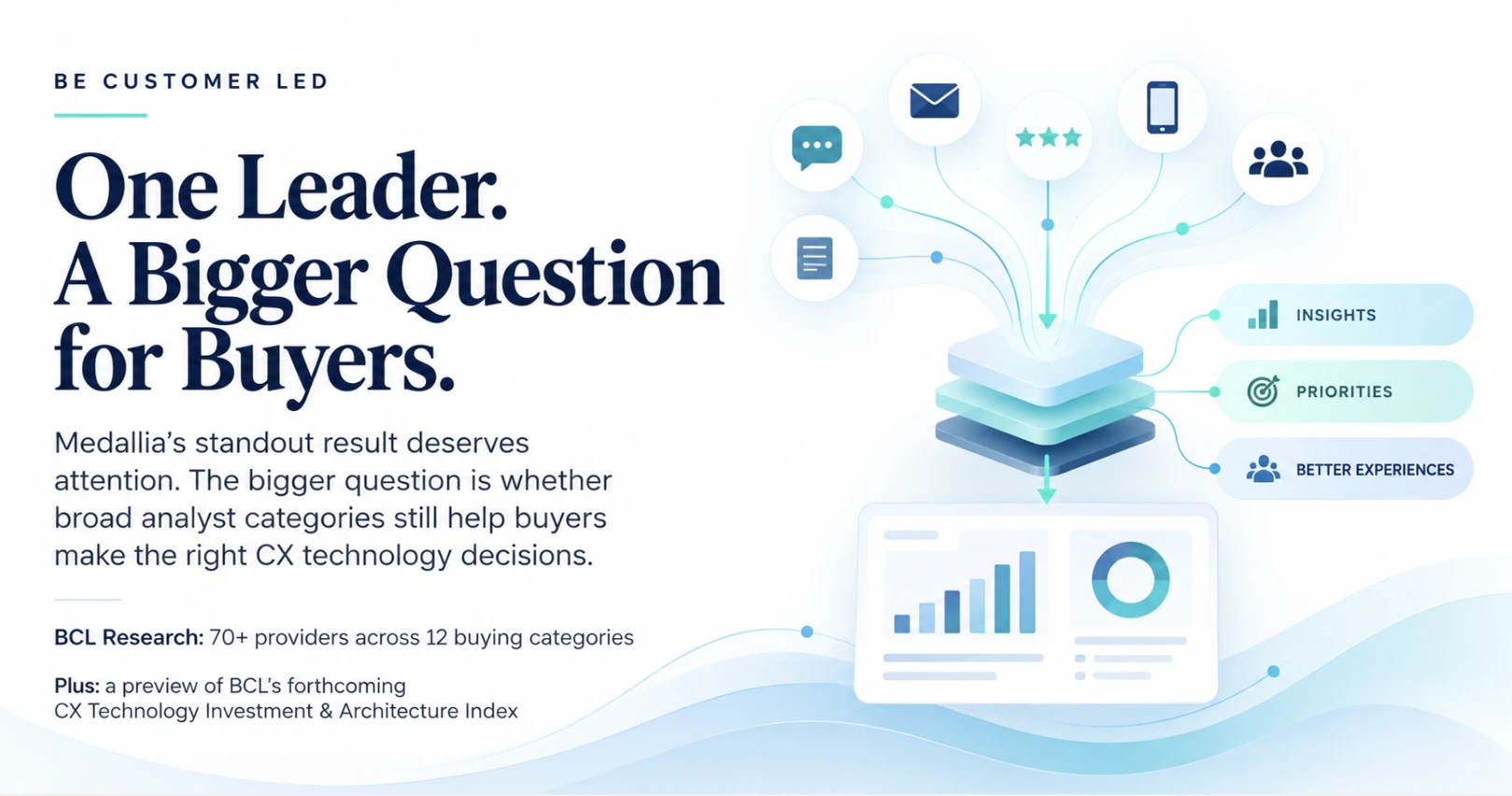
This is one of the reasons I built The CX Technology Market differently. I looked at more than 70 providers across the CX technology landscape and separated them into 12 buying categories.
While I was amazed I got it to 12 categories, I did so because a broad enterprise CX suite shouldn't automatically be compared with a specialist analytics platform simply because both analyze customer signals.
A conversation intelligence platform shouldn't automatically be compared with a journey management platform because both can identify customer friction.
A company focused primarily on resolving customer service issues through AI shouldn't be evaluated against a feedback management platform simply because both improve customer experience.
The buyer should first determine what problem they need to solve, then identify the type of capability required, then determine which providers genuinely compete for that job, and only then does relative vendor strength become particularly useful.
That’s why the research I published includes explicit inclusion criteria, use-case fit, best-fit guidance, and buying questions rather than simply producing one overall ranking of the CX technology market. I think think it gives buyers a stronger starting point and buyers of the research have been praising it’s depth and breadth.
The next question is becoming even more important
There is another reason I think the traditional model needs to evolve. Increasingly, the buying decision isn't simply which vendor should we buy?
Companies now have more choices about how a capability gets created. They can buy a complete application, they can build parts of the capability themselves, they can combine models, customer data, cloud infrastructure, workflow technology, and specialist applications into something much more composable.
And in some technology categories, the smarter decision may be to spend less rather than buy anything new.
That thinking is behind the next piece of research I’m developing at Be Customer Led, the CX Technology Investment & Architecture Index Coming soon.
Rather than starting with vendor rankings, it asks a different set of questions across the CX technology stack.
Specifically, I am help answer, “How strategically important is this capability going into 2027?” “Should organizations fund it, maintain it, consolidate it, reduce spending, or exit?” And, “If the capability still matters, should companies buy it, build it, or compose it from other technologies?”
The research then maps relevant providers against those decisions. To me, it feels much closer to the questions I hear buyers asking today. The decision is increasingly about where to continue spending and what architecture makes sense before it becomes a question of which logo wins. And given the market environment, and fear that AI will make a software purchase irrelevant before the next renewal, these are very important questions to answer before you invest in a capability.
This becomes more important as AI collapses categories
I think analyst firms have a particularly difficult challenge ahead. They need categories so they can compare companies, yet AI is making those categories increasingly difficult to maintain.
Customer feedback management is converging with conversation intelligence. Text analytics is becoming a capability rather than necessarily a standalone software market. Research is becoming intertwined with synthetic data and AI. Contact center platforms increasingly generate customer intelligence. Customer data platforms, warehouses, and AI models can recreate functionality that previously required a specialized CX application. And finally, agentic systems will increasingly act on customer signals rather than simply analyze and report them.
The market isn't becoming easier to categorize. It’s becoming less categorical. This makes today's Forrester Wave interesting beyond who appears where on the chart.
Medallia deserves the recognition it received. The company appears to have done an unusually strong job building a broad platform and communicating a clear strategy for where this market is headed.
I also understand why a company such as Cresta now belongs in the conversation. Predictive CSAT is a perfect example of how a capability that historically belonged to one market can be recreated through an entirely different technology approach.
The question for buyers is what to do with that convergence. I still see considerable value in analyst research. I've used Forrester and Gartner throughout my career, both as a buyer and as someone working in this market.
But I think buyers increasingly need another layer of research alongside it, and one that begins with the problem the company needs to solve.
It’s also one that distinguishes between providers that happen to qualify for the same market, and providers that are genuine alternatives for the same buying decision.
And increasingly, I think it’s one that asks whether you should buy another platform at all. That’s the perspective I'm trying to bring to the research at Be Customer Led, because knowing which vendor leads a category is useful.
Knowing whether you're shopping in the right category in the first place may be even more important.