
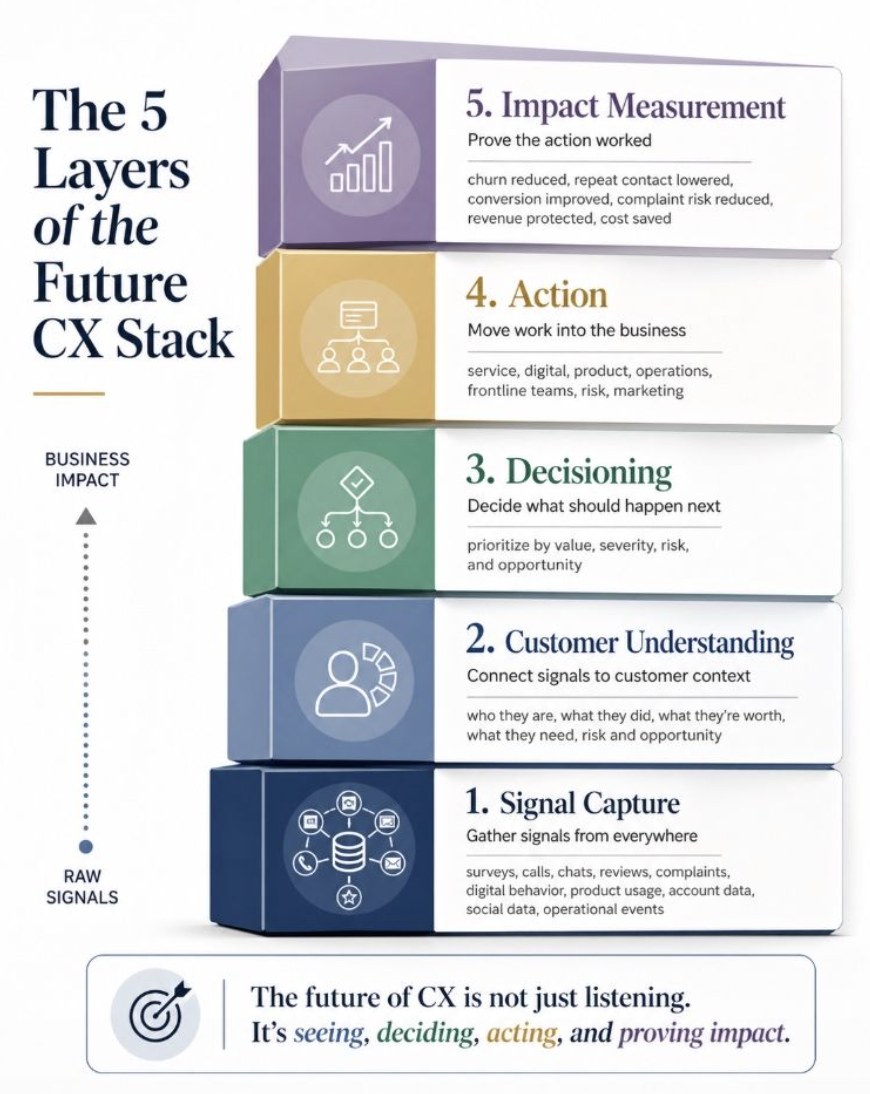
Most CX programs are overbuilt at the bottom and underbuilt where money actually gets made; check out the image for reference. Is this you?
You hear the customer in twenty different ways, but still can’t get the business to stop creating the same pain. That’s why so many CX teams are busy, but invisible, and quietly losing influence, budget, and people. Listening is no longer the hard part. Analytics, on some level, are quickly being commoditized. Companies have access to tons of signals from surveys, calls, chats, reviews, complaints, product usage, account data, social posts, digital behavior, and frontline notes. The problem is what happens after the signal lights up.
Take banking. A customer applies for a credit card, gets approved, waits too long for the card, calls the contact center, gets transferred twice, hears two different answers, and then vents in a survey after the damage is already done. The CX team captures the feedback, codes the issue, adds it’s on a dashboard, and maybe included in a monthly report. What changes?
The card fulfillment process still has gaps. The contact center still doesn’t have clean information. The digital team still isn’t showing their status. Operations still owns one piece, risk owns another, and product owns yet another. Nobody owns the full customer problem, so the customer keeps paying the price for the company’s internal design.
This, in short, is the failure point.
Signal capture matters, but it’s only the first layer. Customer understanding matters, but it’s still not enough. The work starts to become valuable when the company can decide what should happen next, move that decision into the business, and prove whether anything actually changed.
Too many CX programs still can’t tell you which internal behavior changed, which cost came out, which repeat contact was prevented, which customers stayed, which risk was reduced, or which revenue was protected.
And that’s why the old CX model is running out of road. Fast. The next version of CX has to be much more commercially serious. It has to connect customer signals to business decisions, operating changes, and financial outcomes. Not in theory.
The center of the work isn’t NPS or CSAT. It’s action. Start asking questions:
Who owns the fix?
What’s the value of solving it?
What customer behavior are we changing?
What internal process, policy, system, or incentive created the problem?
How will we know if the change worked?
If those questions aren’t being answered, this is your litmus test, which is: would the company would make worse decisions if CX wasn’t around? Customers are done giving companies free consulting while the same broken moments show up.
This is exactly what I’m showing subscribers how to fix in my newsletter, ‘AI, Not KPI’. Because you can’t jump to Level 5 overnight. I'm giving you the tools to build the foundation of each level, so you create value as you move up the ladder.