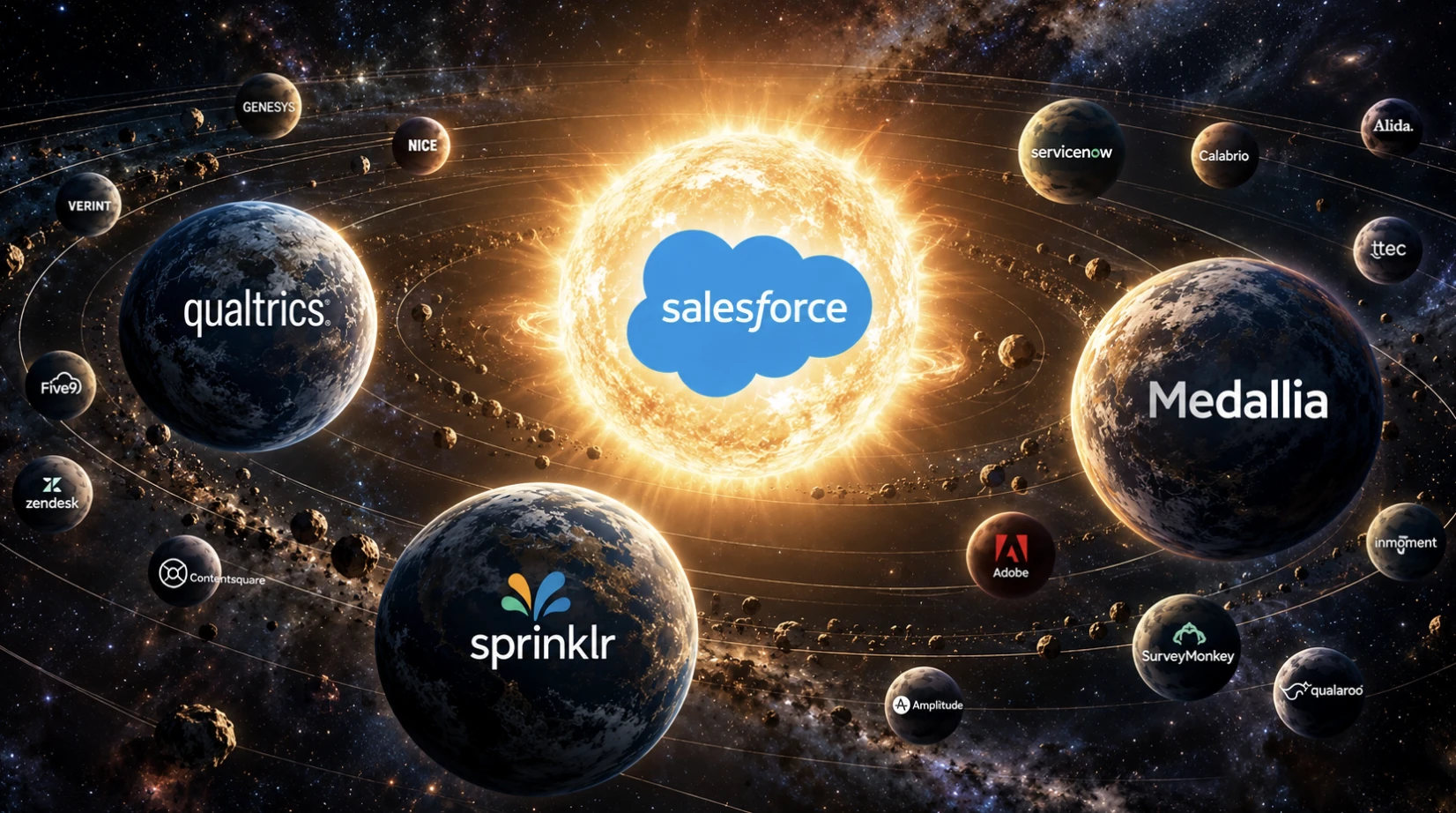

Something important happened in customer experience technology this week, and the market has not fully absorbed what it means. In fact, most missed the news.
TechCrunch reported that Listen Labs , a three-year-old AI research company, walked away from a signed $125 million Series C that would have valued the company at $1.5 billion while Salesforce was reportedly discussing an acquisition at around $2 billion. Listen Labs is said to have roughly $30 million in annualized revenue, so at the rumored price Salesforce would be paying a multiple that looks extraordinary by almost any conventional software measure. (For context, this would be 67X revenue; typical B2B SaaS multiples are ~4-5X revenue, and in 2021 you would have seen top 100 cloud companies go for ~30X ARR.)
You could dismiss that as another example of AI valuations getting ahead of themselves, and could be some truth to that. But why does Salesforce believe an AI research company is strategically important enough to command that kind of price.
Well, the answer points to something way bigger than AI-powered customer interviews. I believe that it suggests that the traditional customer experience management (CXM) software market is beginning to come apart, and I think there is a reasonable chance that five years from now CXM will no longer exist as the distinct software category we recognize today.
Now, I am NOT saying that customer experience won't matter. It will, enormously. But the software boundaries we built around it may not.
Let's look at what Salesforce is assembling
The Listen Labs news becomes much more interesting when you look at it alongside the rest of Salesforce's strategy.
Salesforce has already built one of the world's largest repositories of customer identity, account history, sales activity, service interactions, marketing activity, commerce data, and operational information. Data Cloud gives it another layer for bringing customer information together, while Agentforce is intended to make that information usable by AI agents across workflows.
Now add Fin, which Salesforce recently acquired for $3.6 billion. Fin gives Salesforce an AI agent capable of resolving customer issues across multiple service channels, which means Salesforce is no longer limited to recording interactions or helping employees manage them. It can increasingly participate in the interaction itself.
Listen Labs adds a very different capability. Rather than waiting for customers to leave feedback, open a ticket, answer a survey, or behave in a way that needs to be interpreted later, an AI research platform can actively talk to customers and generate new understanding whenever the organization needs it.
When you put all of these assets together, the shape of Salesforce's ambition starts to become pretty clear to me. It could know who the customer is, observe what the customer does, talk to the customer when additional understanding is required, interpret what matters, decide what should happen next, take action through a person or AI agent, watch the result, and use that outcome to inform the next decision.
You know what this reminds me of? It's remarkably close to the full customer loop.
For the past twenty years, we have broken that loop into separate software categories and bought applications around each one. We have CRM platforms, survey platforms, social listening tools, contact center analytics, digital analytics, customer research platforms, customer intelligence tools, journey management platforms, product analytics, customer service applications, and increasingly an assortment of AI products layered across all of them.
It's super clear that AI is beginning to make many of these boundaries far less useful.
Traditional CX functionality is becoming inexpensive & widely available
The first generation of modern CX technology grew up around a simple idea: ask customers what they think, analyze what they tell you, and distribute that information through the organization so they can take action. Classic "inner-" and "outer-loop" stuff many of us grew up on.
The industry became considerably more sophisticated over time. Platforms such as Medallia and Qualtrics expanded into conversations, digital behavior, operational data, predictive analytics, employee signals, and much more. Yet a surprising amount of the underlying CX operating model still followed the same sequence of collecting information, analyzing it, presenting it to someone, and expecting a human being to determine what happened next.
Generative AI changed the economics of that model dramatically. CX teams have been trying to catch up since because some of the capabilities they used were late to the party on AI features and functionality.
A company like Listen Labs can conduct qualitative customer conversations at a scale that would have been prohibitively expensive only a few years ago. Outset is pursuing a similar model with AI-moderated interviews and automated research synthesis. At the same time, large language models can analyze enormous amounts of calls, chats, reviews, tickets, surveys, social conversations, and other unstructured information without requiring teams to manually sample, code, and categorize everything first.
Capabilities that once helped justify a separate technology purchase are therefore becoming easier to reproduce. Transcription, summarization, basic sentiment analysis, theme identification, natural-language querying, and straightforward synthesis are quickly becoming expected capabilities rather than meaningful points of differentiation.
Now, that doesn't mean these capabilities no longer have value. It definitely means they are becoming much harder to charge a premium for, especially when companies like Microsoft, Salesforce, ServiceNow, Google, OpenAI, Anthropic, Snowflake, Databricks, and dozens of specialist companies can make similar functionality available in different parts of the technology stack.
The implications for buyers are equally as serious. As companies go through their next budget cycle going into Q4, CIOs and CFOs will have to look at stacks containing CRM, CCaaS, VoC, digital analytics, social listening, customer research, product analytics, customer intelligence, journey management, and AI platforms and ask why they still need every one of them.
So if there is one question CX software vendors need to be preparing for now, it's this. GTM and Product Marketing CXM SaaS leaders are scrambling this week.
Qualtrics appears to see the shift coming
One of the more interesting coincidences was Qualtrics announcing its new XM Data & AI platform on September 9th, the same day TechCrunch published the Listen Labs story. Not saying these are connected in any way, but you have to imagine that someone, somewhere wanted to break that story on the same day.
If you missed the event, Qualtrics is describing its future as a “system of decision,” built around human experience data that can help organizations understand what is happening, predict what may happen next, and determine which actions should be taken. I think that is a much more consequential positioning change than another product announcement. It aligns with my previous views on "experience as infrastructure" that I've posted about here.
Qualtrics has assets that most AI startups would struggle to recreate. It has decades of research methodology, enormous quantities of structured experience data, benchmarks, panels, enterprise workflows, deep customer relationships, and an installed base that spans many of the world's largest organizations. Its acquisition of Press Ganey Forsta adds even more proprietary experience data and vertical depth, particularly in healthcare.
The opportunity is to turn those assets into an intelligence layer that machines can reason over continuously, rather than keeping them primarily inside applications designed for analysts (the human kind) and CX teams.
The challenge is that Salesforce is approaching the same problem from another direction. Qualtrics starts with human understanding and is moving toward prediction, decision, and action, while Salesforce starts with the operational customer record and is adding understanding, reasoning, and autonomous execution.
Those paths are starting to meet in the middle, which is why the Listen Labs story matters so much.
To be fair, Medallia has a credible path too
Medallia has also spent years broadening beyond surveys, and that gives it a potentially defensible position as the market evolves.
Its platform can bring together direct feedback, conversations, digital behavior, operational data, social signals, and other sources so companies can understand what customers are experiencing without depending on a survey response to tell them. So the shift toward combining expressed and observed behavior is going to become more important as traditional feedback collection loses some of its privileged position inside CX programs. Perhaps that's what their focus will be with the $150 million in fresh powder they received from Blackstone, Apollo Global Management, Inc., and KKR.
All that said, the risk is similar to the one facing Qualtrics. When Salesforce, ServiceNow, Genesys, NiCE, Snowflake, Databricks, and other major platforms can perform increasingly sophisticated analysis themselves, Medallia has to prove that the independent experience layer produces better decisions than those platforms can make with their native data.
I think it is ultimately a very healthy problem to solve for in the CX industry.
Sprinklr may face a more difficult strategic question
Sprinklr's position is slightly different because it spent years building one of the broadest application portfolios in the category. Customer service, social, listening, marketing, insights, and experience management all sit within the broader platform, and historically that breadth gave large companies a reason to consolidate multiple point solutions.
AI creates an interesting tension for that strategy.
Broad suites remain valuable when integration between capabilities is difficult. As AI agents and modern data architectures make it easier to connect specialized capabilities, however, buyers may become less convinced that they need every function to live inside one large application environment.
That doesn't mean Sprinklr suddenly becomes irrelevant. The company has valuable data assets, significant enterprise relationships, strong social and multimodal listening capabilities, and a large installed base. But its relatively modest recent growth suggests that the market is already forcing customers to think more carefully about where broad CXM suites create enough differentiated value to justify their cost and complexity.
This is where technology rationalization becomes inseparable from CX strategy. The question for buyers is increasingly going to be less about which CX suite has the longest feature list and more about which capabilities need to remain applications at all.
So what's becoming more interesting in this market?
I think it's platforms that deliver on the customer context deserve attention.
No company wants an application where every employee spends their day doing CX work. Architecture needs to sit between the systems where customer signals originate and the systems where people and AI agents make decisions and take action. This is a distinction becomes increasingly important as organizations accumulate more data, more software, and eventually more AI agents.
A company might have customer information spread across Salesforce, Zendesk, Genesys, Snowflake, product telemetry, surveys, reviews, calls, chats, research, operational systems, and several AI applications. None of those individual systems has a complete picture of what the customer is experiencing, why something is happening, what the company has already done about it, or whether those actions worked.
A company like Birdie (full disclosure, I am an advisor to Birdie at this time of this publication) is building around that problem by creating persistent customer context across those sources. Its approach combines taxonomy, customer signals, root causes, business impact, organizational initiatives, and outcomes so that understanding can travel with the decision rather than remaining trapped inside another tool, AI-enabled or not.
The even bigger story here is that this all becomes particularly valuable as AI agents proliferate.
An AI service agent doesn't simply need a transcript. A product agent doesn't simply need a list of feature requests. A retention agent doesn't simply need a churn score. Each one needs enough context to understand what happened, how that experience relates to other signals, which customers are affected, what may be causing the issue, what previous interventions have been tried, and how those interventions improved the outcome, if at all.
Companies that can create and maintain that context will occupy a much more valuable position than companies whose primary role is analyzing another batch of feedback.
The amount of customer data is about to explode
There is a tendency to assume AI will simplify customer technology because fewer people will need to touch the underlying systems. Operationally, that may be true in some cases, but from a data perspective the opposite will happen.
AI will create substantially more customer information. Let's take a single customer service interaction as an example. It might eventually produce the original conversation, an AI-generated summary, agent actions, model reasoning, changes to a CRM record, behavioral events, satisfaction data, follow-up workflows, operational outcomes, and additional interactions between company agents and customer-controlled agents.
Now, multiply that across millions of customers, dozens of channels, and potentially hundreds of AI agents operating inside a large enterprise. Clearly the scarce resource will not be data here. Companies already have more than they can possibly use. As a result, I think the scarce resource will be coherent context.
Which signals belong together? Which customers are affected? What changed? What is causing the problem? How significant is it? What is the commercial impact? Has the organization seen this before? What did it do last time? Did the intervention work? Should a product team change something, should an agent behave differently, should an employee receive coaching, or should the company deliberately do nothing because the issue doesn't justify the investment?
These are all decision questions, not reporting questions. So the future CX tech stack will increasingly be built around answering these questions.
Three layers eventually replace today's CXM category
If I were designing the customer technology market five years from now, I wouldn't start with VoC, customer intelligence, social listening, journey management, research, contact center analytics, or most of the categories we use today.
I would start with just three layers: interaction, context, and action.
The interaction layer includes the places where companies and customers engage with a brand. Salesforce, Fin, Genesys, NICE, ServiceNow, Zendesk, websites, mobile apps, messaging platforms, conversational AI, and eventually customer-controlled agents all belong here.
The context layer connects customer identity, behavioral information, conversations, research, operational signals, feedback, business metrics, and organizational history into something that both humans and machines can understand. The large CXM players already have significant assets that could allow them to compete for this position. I would expect Snowflake, Databricks, Salesforce, and others to push further into the same space, even as players like Birdie are already there.
The action layer is where something actually changes. AI agents, employees, product teams, service operations, marketing platforms, workflow systems, and automation tools use the available context to decide what should happen and then execute against that decision. There are household names already playing in this space, including Salesforce, Microsoft, Pegasystems, Adobe, Sierra, Decagon, and Ada.
Once you look at the market through those three layers, many of today's category definitions begin to feel like artifacts of an earlier technology architecture.
We (meaining the Forresters and Gartners of the world) created separate categories because each type of data required its own application, analytical approach, user interface, and workflow. AI has far less respect for those boundaries, and thankfully so. A model doesn't care whether information originated in a survey platform, a call transcript, a CRM record, a research interview, a review, or a product analytics system. It cares whether the information is trustworthy, relevant to the decision being made, and available in the moment it is needed.
All of this, by the way, significantly changes what customers will ultimately pay for.
CXM doesn't vanish overnight. It gets absorbed.
When I say CXM software could be gone in five years, I don't mean Qualtrics, Medallia, Sprinklr, and every other company associated with customer experience disappear.
Some of them may become considerably larger. Others will be acquired, become infrastructure providers, consolidate with adjacent categories, or see pieces of their functionality absorbed into broader technology platforms. It's still shocking to me that there have been 40+ M&A transactions in the broader CX space over the last 10 years.
What I do think disappears is the idea that Customer Experience Management remains a clean and independent software category with a predictable collection of applications sitting around it.
Research is moving into AI platforms and synthetics. Customer service is moving into autonomous agents. Analytics is moving into foundation models and data clouds. Customer data is consolidating inside cloud data platforms. Workflow is becoming increasingly agentic. Measurement is moving closer to operational and financial outcomes rather than sitting primarily inside CX dashboards.
As these boundaries collapse, owning another application becomes less important than owning the customer context that travels between them.
That is what makes Salesforce's interest in Listen Labs worth paying attention to. Salesforce appears to recognize that customer understanding becomes much more valuable when it sits directly beside customer identity, operational data, AI agents, workflow, and execution.
I have to assume that every CX technology company should be asking what that means for its own position. If they're not, you should expect those brands to disappear in the next five years because they have no idea what's happening around them.
If your primary value is collecting information, analyzing it, and presenting it back to a human being, the next five years could be difficult. If you can maintain a persistent understanding of the customer, make that context available wherever decisions are happening, help humans and machines determine what should happen next, and then establish whether those actions produced a meaningful business outcome, the opportunity may actually be getting larger.
The category we've called CXM for the past twenty years may be approaching the end of its useful life. What replaces it will be far more important.