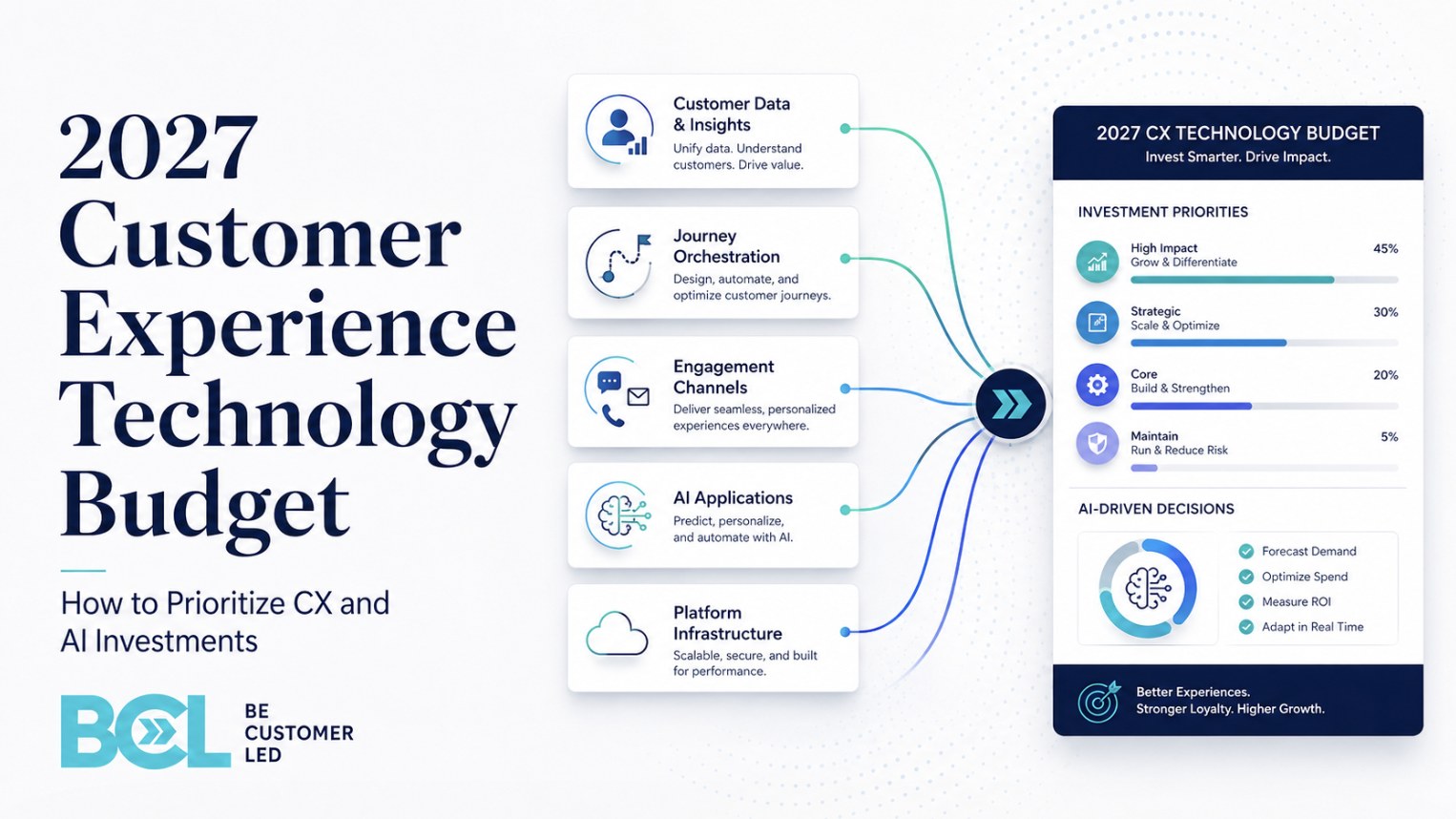
Over the next few months, companies will make some of their most important customer experience technology decisions for 2027.
Many will ask familiar questions, like:
- Which platforms should we renew?
- Which AI tools should we add?
- Which vendors belong in the budget?
- Which roadmap items can we push into next year?
Those are reasonable questions, but I think they start one step too late.
The better question for 2027 is this:
If we were building our customer experience technology environment from scratch today, how much of what we currently own would we buy again?
Most companies cannot answer that cleanly.
That is a problem because 2027 is not shaping up to be a normal budget year. AI spending inside customer service is rising much faster than the budgets that contain it. In August 2026, Gartner reported that AI spending among customer service leaders increased 38%, while overall service and support function budgets grew only 2%.
To me, this gap means companies are not simply adding AI to the edge of the existing operating model. They are being forced to reallocate money. Some of that money will come from people. Some will come from legacy platforms. Some will come from projects that no longer deserve funding. Some will come from technology that was purchased for a category that no longer makes sense.
This is where many 2027 CX technology budgets will go wrong. They will fund the categories they already understand instead of the problems the business actually needs to solve.
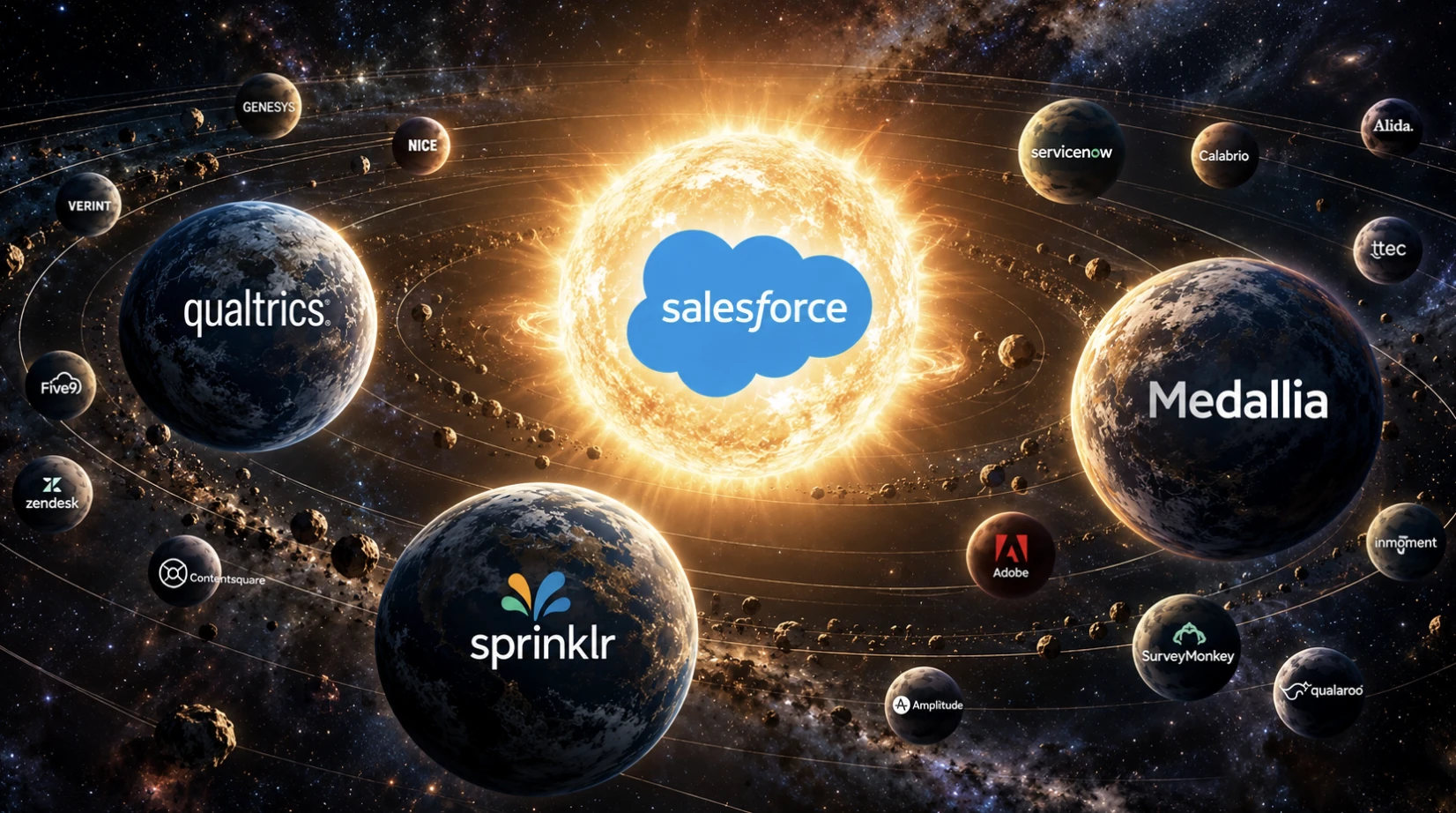
Customer experience technology has become much harder to buy. Voice of customer, conversational AI, conversation intelligence, quality management, agent assistance, customer analytics, journey analytics, customer intelligence, CRM and contact-center analytics are no longer cleanly separated markets. The lines are blurring because AI is changing what each platform can do. This creates a very practical problem for buyers.
A company may have one platform analyzing support calls, another analyzing survey comments, another scoring agent performance, another summarizing conversations, another identifying customer pain points, and another creating operational dashboards. Each purchase may have made sense when it was approved. In 2027, the combined environment may be duplicative, underused, expensive, and disconnected from the outcomes executives actually care about.
Put simply, the issue isn’t that companies bought bad technology; it’s that the market moved.
AI is collapsing functionality across categories faster than most budget processes can adapt. Gartner has also estimated that up to $234 billion in enterprise application software spending could be exposed to agentic AI disruption by 2030.
That does not mean every SaaS platform disappears. However, it does mean leaders should expect software value to shift away from features, seats, and dashboards, and toward completed work, better decisions, lower cost, faster resolution, improved retention, and measurable business impact.
This is a very different buying standard relative to what we see today.
Forrester’s 2027 budget planning research points in the same direction. More than 80% of business and technology leaders expect budgets to increase over the next 12 months, and 55% of CX leaders expect spending growth of 5% or more. But Forrester also warns that more spending without stronger data foundations, operating models, and AI readiness can make fragmentation worse.
So a company can spend more money and still end up with a weaker customer experience technology environment.
More vendors. More dashboards. More AI features. More disconnected data. More internal debate about which system is the source of truth. More cost with no clear connection to customer behavior, employee performance, revenue, retention, or operating efficiency. More, more, more.
Before any company approves its 2027 CX technology budget, it should be able to answer five questions.
First, what customer or operating problem(s) is each platform supposed to change?
This sounds pretty basic, but it is often missing. Platform funding gets approved because it belongs to a recognized category, supports an existing team, or has been in the environment for years. That simply isn’t enough anymore.
Every significant CX technology investment should connect to a business problem. Faster issue resolution, lower service cost, better frontline coaching, higher digital containment, improved product feedback loops, stronger retention, fewer repeat contacts, better conversion, and faster recovery when something goes wrong all come to mind.
Second, how much are we really spending across the customer experience technology environment?
Many companies know what individual departments spend. Fewer know the full number across service, customer experience, marketing, product, digital, research, analytics, technology, and business units.
CX technology spend is often fragmented by ownership. One group funds surveys, another funds speech analytics, another funds contact-center technology, another funds digital analytics, another funds customer data infrastructure, and another funds AI pilots.
Each team may be managing its own budget responsibly, but the enterprise may still be overspending.
The real number has to include software, implementation, services, integrations, internal support, data work, unused licenses, overlapping modules, and vendor expansion commitments. Until that view exists, leadership is making budget decisions from partial information.
Third, where are we paying multiple vendors for similar capabilities?
This is where the tech stack becomes expensive.
A company may pay for text analytics in one system, call summarization in another, quality scoring in another, customer sentiment in another, root-cause analysis in another, and workflow automation somewhere else. The labels are different. The commercial models are different. The buying teams are different.
But the capabilities may now overlap. Also, because your enterprise is broken up into different product or business lines, you might even have the same technology in each silo (and with each silo paying a different price for the same tech…yes, I’ve seen this).
That does not always mean consolidation is the right answer. Sometimes the specialist platform is materially better. Sometimes the incumbent suite is good enough. Sometimes an AI-native vendor can change the economics entirely. Sometimes the right answer is to keep two systems because they serve different decisions. And sometimes you want each business or product area to have their own instance. The point is that the decision should be explicit.
Fourth, which AI capabilities should we buy, which should come from existing platforms, and which should we build or configure ourselves?
This may be the most important 2027 budget question.
AI is now everywhere, to the point where “AI native” now feels quaint. Every incumbent vendor has an AI roadmap. Every new vendor claims some form of intelligence, automation, agentic capability, or decision support. Every internal technology team is being asked whether they can build something faster or cheaper.
The answer cannot be the same for every use case.
Some AI capabilities should come from existing platforms because the data, workflows, permissions, and users already live there. Some should be purchased from specialist vendors because the problem is specific, high-value, and poorly solved by incumbents. Some should be built or configured internally because the use case depends on proprietary workflows, customer data, operating rules, or business logic.
The mistake is treating “AI” as one budget category, when it is fundamentally not.
AI should change how the company evaluates the entire customer experience technology environment. It should force a serious discussion about what still needs to be purchased as standalone software, what should be absorbed into existing platforms, and what should become part of the company’s own operating system.
Fifth, what measurable business outcome justifies renewing each major investment?
Renewals will force more scrutiny in 2027. They just will.
Many technology budgets are shaped by what is already in the stack. The renewal becomes the default. The new investment gets the tougher review.
This logic is just backwards.
Every major renewal should have to earn its way back into the budget. Not through a usage report alone. Usage is not impact. A team can use a platform heavily and still fail to change the business. The better standard is outcome.
Did the platform reduce cost? Improve retention? Increase conversion? Shorten time to resolution? Help teams identify and fix recurring customer issues? Improve employee performance? Speed up product decisions? Reduce risk? Prevent avoidable churn?
If the answer is unclear, the renewal should be challenged, renegotiated, reduced, or redesigned. This is not just a procurement exercise; it is a strategy exercise.
The reason many companies struggle with these questions is that the answers sit in different places. Procurement has the contracts, but the budget, architecture, pain points, etc. all sit in different parts of the company. No single function owns the full picture.
A proper 2027 CX technology budget review should produce six outputs
- A complete inventory of current CX technology spend.
- A capability map that shows where platforms overlap, where gaps exist, and where AI changes the role of existing vendors.
- A clear view of which tools should be renewed, renegotiated, consolidated, replaced, or retired.
- A practical AI investment plan that separates vendor-funded AI, incumbent-platform AI, and internal build or configuration opportunities.
- A business outcome view that connects each significant investment to cost, revenue, retention, customer behavior, employee performance, risk, or speed.
- A 12-to-24-month roadmap that shows what should change now, what should wait, and what should stop.
The economics can be material
If a company spends $5 million a year across its customer experience technology environment, finding 10% in duplication, underuse, or avoidable spend creates $500,000 that can be returned to the business or redirected toward higher-value AI investments.
This number scales, of course, and that’s before accounting for better productivity, faster decisions, lower service cost, fewer repeat contacts, or improved retention.
This is why 2027 CX technology planning should begin with an independent view of the environment the company already has. Not because vendors are bad. Many are building useful capabilities. But vendors are naturally paid to expand their footprint. Analysts are often paid to define markets. Internal teams are often paid to protect the systems they already use.
Companies need a different lens. They need to understand the customer and operating problems worth funding, the capabilities they already own, the places where AI changes the economics, and the investments that no longer deserve budget.
At Be Customer Led, we help companies do this before they lock their 2027 budgets. The work is designed to answer four questions:
- What should we keep?
- What should we stop paying for?
- Where should we invest?
- How should AI change the plan?
The output is a clear executive view of current spend, capability overlap, vendor decisions, AI priorities, and the 2027 investment roadmap.
The companies that get this right will not be the ones that buy the most AI. They will be the ones that stop funding outdated assumptions about how customer experience technology works.
Because the budget question has changed. It is no longer, “Which CX tools should we buy?” It is, “Which customer and operating problems deserve funding, and what is the smartest way to solve them now?”
If your organization is setting its 2027 customer experience technology budget, this is the moment to take a harder look before the money is committed.
Contact us at info@becustomerled.com if you would like to explore how we can help.