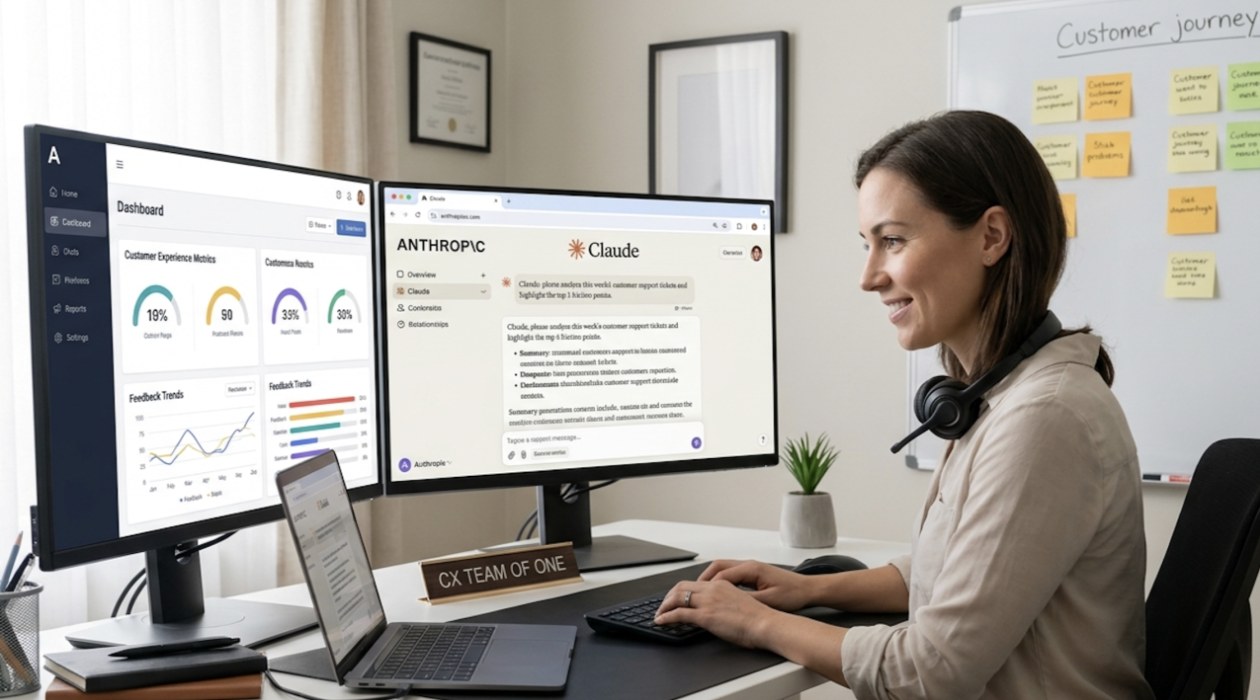
I have been thinking a lot about AI’s impact on the CXM space, and not in the abstract way this topic usually gets discussed. I mean the real-world version, where CX is not a department with layers of analysts, researchers, and operations people behind it. In most companies, CX is one person; if you're lucky, sometimes it's two or three. That's the actual operating environment, and it changes the question completely.
Over the weekend, I kept coming back to something practical. If you are that lone CX person, or part of that very small team, how do tools like Anthropic’s latest releases actually help you understand the experience your company is delivering? And what if the constraint was you didn't have a budget for a SaaS platform and surveys aren't part of the plan? The answer is not “use AI to summarize feedback faster.” That is way too shallow. The real opportunity is to use Claude as a working layer that can read, sort, connect, and explain the operational evidence your business already creates every day. Anthropic’s current stack is materially more useful for that than earlier generations because Claude Sonnet 4.6 and Opus 4.6 now support a 1M-token context window, adaptive thinking, and broader agent-style work, while Anthropic’s MCP connector allows Claude to connect to remote MCP servers for access to external tools and data sources. Anthropic also positions Cowork as a multi-step knowledge work system rather than a simple chat tool like the free versions offer today.
I think the above point matters because the biggest problem for a small CX team is the lack of capacity to read the signal already sitting inside the company. Support tickets, chat transcripts, call transcripts, complaint emails, onboarding notes, cancellations, refunds, CRM comments, help-center searches, account escalations, product bugs tied to customer pain, and messy internal threads together tell a far richer story than most survey programs ever will. We're now at a point where one person can absorb enough of it, organize it intelligently, and turn it into a clear point of view that the business can act on. That is the gap Anthropic closes.
Going from zero to one does not mean creating a complete measurement architecture. It means proving that you can take one business problem, one small set of operational evidence, and one AI workflow, then use them to produce a finding that is sharper than what the business had before and useful enough that someone changes something because of it. That is the bar. If you clear that bar once, you have a foundation. If you do not, all the talk about AI is just performative.
So the first thing I would do is choose a problem that is narrow, important, and politically legible. “Help me understand the customer experience” is not a real starting point. It is too broad, and it invites generic output. A much better opening move is to focus on something like repeat contact, failed self-service, early cancellations, onboarding friction, billing complaints, or an escalation spike in one product area. A solo CX operator needs the first use case to be specific enough that the analysis can be judged against reality. If the question is “Why are customers contacting us more than once within seven days for the same issue?” then the answer can be tested, debated, and improved. If the question is “What are customers feeling?” you are already drifting toward mush.
Once the question is defined, I would map only the data sources that sit closest to that problem. This is where judgment matters more than tooling. For repeat contact, I would start with support tickets, call transcripts, and chat logs. For failed self-service, I would add help-center searches, article views, chatbot logs, and the support interactions that followed those attempts. For onboarding pain points, I would look at implementation notes, CRM updates, early support cases, onboarding emails, and cancellation reasons from the first 30 or 60 days. For billing issues, I would want payment-related cases, refund requests, account notes, and any transcript evidence tied to billing confusion. A small team can only be successful by choosing the few sources most likely to reveal what really happened.
This is also the point where people hear “MCP” and assume they need a complex technical setup before they can begin. I do not think that is the right way to start. Anthropic’s MCP connector is real and increasingly important because it gives Claude a standardized way to connect to remote MCP servers and reach external tools and data sources. Anthropic’s docs also make clear that remote MCP servers are not owned or endorsed by Anthropic, and that users should connect only to servers they trust and review each server’s security practices and terms before using them. That is important, but it should not become an excuse to wait. My advice is to begin with exports and lightweight access first, then move toward MCP-based connectivity once the use case is proven and the right internal partners are engaged.
A one-person CX team needs learning before elegance. You do not need a perfect connection architecture to learn something meaningful from 30 days of support data and a batch of transcripts. You need the right files, a clean problem statement, and enough discipline to ask good questions. In practical terms, that means asking support operations for a case export, asking the contact center lead for a transcript sample, asking RevOps or finance for cancellation or refund reasons, asking the help-center owner for search logs, and asking the CRM admin for the notes tied to the segment you care about. Most small teams can get that done far sooner than they can get a fully approved live connection into every system.
If I were teaching a novice CX lead to do this well, I would have them create a simple analysis brief before they touched Claude. The brief should explain what problem they are trying to understand, what time window they are examining, which customer segment matters, what sources are included, what should be excluded, and which root-cause buckets Claude should use when interpreting the data. Those buckets matter a great deal. In most businesses, the real causes of customer pain are not endless. They usually resolve to product defects, unclear policy, weak content, handoff failures, training gaps, staffing problems, broken routing, or setup issues. If you do not force the work into root-cause buckets, the output will stay descriptive and unhelpful. You will learn that customers are frustrated, but you will not be able to show where the frustration starts.
A good first prompt, then, does not ask Claude to “summarize the experience.” It asks something closer to this: “Using these support tickets, transcripts, and help-center searches from the last 30 days, identify the top recurring reasons customers contact us more than once for the same issue. Group findings into product, policy, content, training, staffing, routing, and handoff categories. Show the top five patterns, include representative evidence from the source material, estimate which patterns are creating the most repeat work, and distinguish between one-off complaints and systemic failures.” That is much closer to expert practice. It constrains the model, tells it how to think, and ties the output to a business question rather than a vague research exercise. From there, I would ask Claude to work through the evidence in stages instead of trying to produce one master answer. The first pass should identify recurring patterns.
The second should force root cause.
The third should rank severity, looking not only at frequency but at downstream cost, repeat effort, escalation risk, churn potential, or impact on important accounts.
The fourth should extract evidence so the final output is not a polished interpretation floating above reality.
The fifth should move toward action, identifying the most plausible fixes and who would likely own them.
This staged approach is where the larger context window becomes genuinely useful, because you are not just asking the model to read one document. You are asking it to hold tickets, transcripts, logs, notes, and business rules in memory long enough to find meaningful relationships between them. Claude 4.6’s long context and adaptive thinking are especially relevant in this kind of multi-document analysis.
The output format matters almost as much as the analysis. A one-person CX lead should produce a tight memo that includes the problem being studied, the sources used, the top patterns found, the likely cause of each pattern, the evidence that supports the finding, the business impact as best as you can estimate it, and the one or two actions most worth testing first. The purpose of this document is not to prove that AI can write beautifully. It is to make the issue hard to dismiss. A product leader, support leader, digital owner, or operations head should be able to read it in a few minutes and understand both what is going wrong and what should happen next. Now, the part most novices underestimate is the partnership model required to make this real. Even a solo CX function does not do this alone. It needs a small working coalition, and the order of those relationships matters. The first and most important partner is support or service operations, because they understand the structure and quality of frontline data better than anyone else. They know which fields are reliable, which queues distort the picture, how dispositions are really used, and where the workarounds live. Without that context, you may interpret the evidence cleanly and still miss what is actually happening.
The second partner is whichever admin or system owner controls the source you need most. That might be the Zendesk admin, the Salesforce admin, the contact-center systems lead, the knowledge-base owner, or the person who governs chat transcripts. These people matter because they help you move from “I think the data exists” to “Here is exactly how to get it, clean it, and trust it.” They also become essential once you want to move beyond exports and toward APIs, scheduled pulls, or MCP-based access.
The third partner is IT or engineering. You need them for authentication, API access, data handling rules, and eventually the technical path to approved connectors or remote MCP servers if you decide to make the workflow more automated. Anthropic’s documentation is explicit that MCP connections involve real external services and authentication, and that remote servers should be vetted carefully. That means your technical and security teams should be involved before you start wiring live systems together.
The fourth partner is security and legal. I would bring them in earlier than most CX teams do. Customer data often includes personal information, financial details, regulated content, or case history that should not be moved casually into a new workflow. Anthropic’s MCP connector documentation notes that the feature is not eligible for Zero Data Retention, which is precisely the kind of detail a security partner will want to understand as you define the safe boundary for use. That means you start with the least risky data possible, clarify which fields can be redacted or excluded, and align on where the analysis will happen and who can access it.
The fifth partner is the business owner who can act on what you find. This is usually where small CX teams lose momentum. They do strong analysis, but nobody is lined up to change the help article, rewrite the policy language, fix the routing logic, adjust the onboarding sequence, or escalate the product issue. So the insight lands, people nod on screen, say, "Nice work!" and nothing moves. From day one, the solo CX lead should know whose team would most likely own the first fix if the analysis proves something important.
If I were turning this into a first-90-days plan, I would organize it in three phases.
In the first phase, I would prove the concept manually. I would choose one use case, gather a limited set of exports, analyze them in Claude, and produce one operator-grade memo with evidence and a recommended action.
In the second phase, I would standardize the method by tightening the taxonomy, standardizing prompt patterns, defining a reusable output format, and agreeing internally on what counts as a meaningful finding.
In the third phase, I would improve the plumbing by working with admins, IT, and security to make data access less manual and, where appropriate, introduce approved MCP connections or other connector-based access so the work becomes easier to repeat and less dependent on ad hoc exports.
There is also a model question hidden inside this. For most solo CX teams, I would use Sonnet 4.6 as the default workhorse because Anthropic positions it as the best balance of speed and intelligence for everyday professional work, while Opus 4.6 is better reserved for heavier, more complex synthesis when the evidence set is broader and the stakes are higher. That is not just a technical point. It is an operating choice. A one-person team needs a daily driver and an escalation path, not a habit of using the heaviest model for everything.
Cowork is relevant here as well, but I would use it carefully. Anthropic describes Cowork as a system that executes multi-step knowledge work such as research synthesis, document preparation, and file management. For a small CX team, that means the tool can do more than analyze evidence. It can help prepare the issue memo, organize supporting files, draft the policy rewrite, assemble the product brief, or prepare the before-and-after artifact for a support leader. That is valuable because the solo CX lead’s real bottleneck is rarely insight alone. It is the amount of follow-through work required after the insight appears.
Small teams lose credibility when the ambition outruns the operating reality. The first real success should be much more modest and much more powerful. It is being able to say, with evidence, “Here is one pattern the business has been missing. Here is where it begins. Here is what it is costing. Here is what I believe we should change first.” When that happens more than once, the function starts to look different. It is no longer the group that asks customers how things felt after the fact. It becomes the group that reads the operational record closely enough to show where the business is making customers work too hard.
That is why I think Anthropic matters more for the one-person CX team than for the large one. Large teams already have process, reporting, and internal visibility. What they often lack is decisiveness. The solo CX lead has the opposite problem. They often see the issue intuitively but lack the time and structure to prove it in a way the business respects. Claude changes that equation. Not by replacing judgment, and not by turning CX into a push-button exercise, but by giving one capable operator far more reading power, synthesis power, and follow-through capacity than they had before.
Hope you found this a little bit helpful and it motivates you to get using and moving. By the way, you can do all of this with ChatGPT if your company is an OpenAI shop instead.